

A product or service only thrives when it aligns with real customer needs. In today’s market, the customer ultimately decides what works. And demand generation marketing is built around that reality. It’s not about pushing or persuading people blindly. It’s more about delivering the right information to the right audience, so they make the decisions faster. For instance, you’re selling high-end noise-cancelling headphones. Promoting them at a loud concert wouldn’t make much sense. People have come there to enjoy the music, not trying to avoid it. But place the same product in an airport, where travelers are tired of constant background noise, and suddenly it becomes highly relevant.
This is the essence of demand generation marketing. By leveraging different touchpoints, it creates consistent visibility and engagement, leading to more authentic and qualified leads.
Turn Strategy into Real Leads
Let Practina handle your Demand Generation from Content to Conversion.
Get Started Now!What is Demand Generation Marketing?
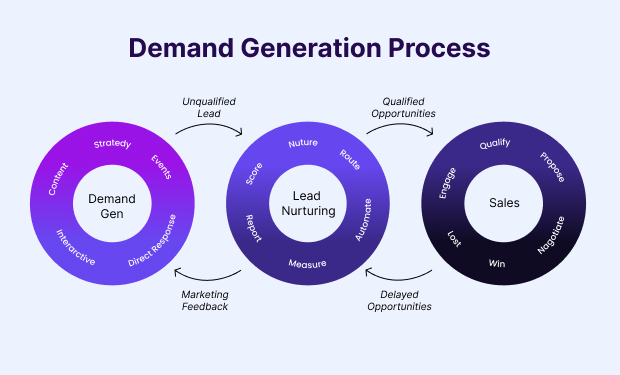
Demand gen, or demand generation marketing, is a strategic approach focused on creating awareness, interest, and trust in your product or service. It is done long before someone is ready to buy. Instead of pushing for immediate sales, it builds a steady pipeline by educating your audience, addressing their pain points, and positioning your brand as a reliable solution.
It works across multiple touchpoints. Starting from content marketing, social media, webinars, email campaigns, SEO, and paid ads, it ends by ensuring the message reaches the right people at the right time. The goal is to guide potential customers through their journey: from discovering a problem, to exploring solutions, to finally choosing your brand.
At its core, demand generation is about relevance and timing. By consistently providing valuable, thought-provoking information, it nurtures interest and converts it into high-quality, intent-driven leads.
The Difference Between Demand Generation Marketing and Lead Generation
Although demand generation and lead generation are closely related, they are not the same. Simply put, demand generation focuses on attracting potential customers by solving their problems and building awareness, whereas lead generation focuses on converting that interest into identified, sales-ready prospects.
The table below breaks it down further:
| Aspect | Demand Generation Marketing | Lead Generation |
| Primary Goal | Build demand and educate the market | Generate qualified leads for sales follow-up |
| Funnel Stage | Top to mid-funnel | Mid to bottom-funnel |
| Approach | Long-term relationship building | Short-term, conversion-driven |
| Audience Focus | Broad audience, including those unaware of the problem | Narrow, high-intent audience already considering solutions |
| Content Type | Blogs, videos, social posts, thought leadership, webinars | Gated content, landing pages, forms, demos, free trials |
| Touchpoints | Multiple, spread across the customer journey | Focused on key conversion points |
| Time Horizon | Takes time to build momentum | Faster, immediate results |
| Metrics Tracked | Website traffic, engagement, reach, brand awareness | Conversion rate, cost per lead, number of leads |
Top 5 Demand Generation Strategies
Here are the key demand generation best practices to help increase awareness of your brand.
Account-Based Marketing
It is a focused demand generation marketing strategy where you treat each target prospect as its own market and create personalized campaigns for them. In this approach, you don’t reach out to a large audience. Instead, you first identify the specific companies you want to win. Then, you customize your messaging, content, and outreach based on their needs and challenges.
ABM accounted for over 47% of the market share in 2024, showing how widely it is being adopted. That said, today, many businesses are also using co-created content to strengthen relationships with key accounts. This includes things like joint webinars, customized white papers, tailored workshops, and solution plans created together with the client.
Key Characteristics of ABM
- Hyper-personalized: Messaging is tailored for every prospect
- Focus on high-value: Targets fewer but better-fit accounts
- Sales + marketing alignment: Both teams work as one unit
- Longer sales cycles: Common in enterprise or B2B deals
- Relationship-driven: Focuses on building trust with decision-makers
Content Marketing
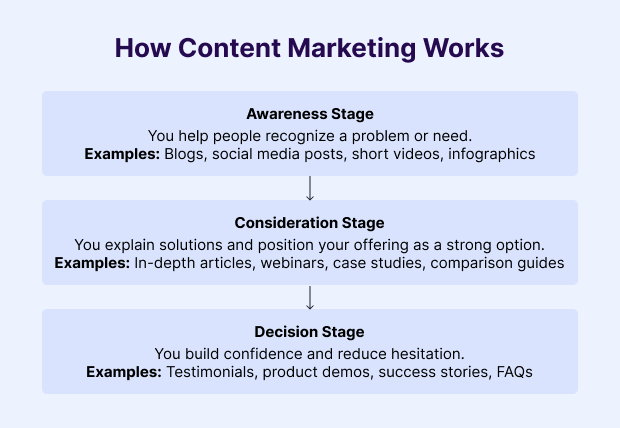
Content marketing for demand generation goes beyond just creating content. It’s about strategically using it to inform, engage, and influence your audience. This approach works because of a simple idea—when people learn something useful from you, they start to trust you. Helpful content builds credibility and shows your expertise. Over time, as people keep engaging with your content, this trust grows stronger, and your brand stays top of mind.
Eventually, this trust leads to an action, whether it’s making an inquiry, signing up, or choosing your product or service. And again, because people already feel confident about you.
Email Marketing
Sending emails to build awareness, nurture interest, and guide potential customers toward your solution is a great demand generation strategy.
Unlike one-off promotional emails, this approach focuses on delivering consistent value. The essence is the same. In place of selling, you’re educating, informing, and staying relevant so that when the need arises, your brand is already trusted.
To exemplify, you run a dental clinic. So, instead of only sending “Book now” emails, you could send:
- Patient success stories
- How to know if you need a dental implant
- 5 common causes of tooth sensitivity
Paid Advertising
Paid advertising is a key driver in modern marketing. By placing ads across relevant channels, you not only increase awareness but also guide potential customers into a more structured demand generation journey, where their interest can be nurtured and captured effectively.
In this approach, ads are not just about immediate conversions. Instead of focusing only on “Buy now” messaging, they are designed to address real pain points and showcase how your solution adds value. This helps you engage with your audience earlier, build credibility, and gradually turn awareness into genuine interest and action.
Key Characteristics of Paid Advertising
- Audience targeting: Instead of broad targeting, you focus on specific segments based on demographics, interests, behavior, or intent signals.
- Strong messaging: Ads highlight pain points and offer value—not just product features.
- Creative formats: Videos, carousels, and interactive ads help capture attention and explain your offering better.
- Retargeting: You re-engage people who have already interacted with your brand, keeping you top of mind.
- Landing page alignment: The ad and landing page must match in message and intent to maintain trust and improve engagement.
Social Media Marketing
With around 5.6 billion users globally, social media has become an essential part of demand generation marketing. It helps you reach your audience where they already spend their time and engage with them regularly. But simply being present isn’t enough. You need to adapt your content to fit each platform.
For instance, LinkedIn is ideal for sharing in-depth knowledge, industry trends, and thought leadership content that builds credibility. On the other hand, Instagram works better for visually engaging and interactive content. For example, quick tips, short videos, or even fun posts that subtly communicate the value of your offering.
Key Characteristics of Social Media
- Consistency: Regular posting keeps your brand visible and relevant.
- Value-driven content: Content should solve problems, answer questions, or provide insights—not just promote.
- Engagement: Replying to comments, DMs, and interacting with your audience builds stronger relationships.
- Platform-specific strategy: Each platform (Instagram, LinkedIn, YouTube, etc.) requires a different content style and tone.
- Storytelling: Sharing real experiences, behind-the-scenes content, and success stories makes your brand relatable.
Track what Matters and Scale what Works
Practina helps you Create, Distribute, and Optimize Campaigns that Drive Real Demand.
Get Started Now!Demand Generation Metrics
- Marketing Qualified Leads (MQLs)
MQLs are prospects who’ve interacted with your marketing in a meaningful way. For example, reading your content, signing up for events, or coming back to your site multiple times. They’re a good fit for your business, but they’re still in the learning phase. It means, instead of selling right away, this is the time to keep educating and building trust.
- Sales Qualified Leads (SQLs)
SQLs are the leads who are ready to take the next step. They’ve gone beyond basic interest and shown clear signals that they’re considering your offerings. These leads are passed to the sales team because they’re closer to making a decision. Simply put, they reflect how effective your marketing is at bringing in leads that can turn into customers.
- Cost Per Lead (CPL)
This demand generation marketing metric is all about understanding your spending per lead. It takes into account your ad budgets, content creation, and campaign costs, and compares that to how many leads you generate. This metric helps you figure out where your money is being used effectively and which channels are delivering leads at a lower cost.
- Cost Per Acquisition (CPA)
CPA measures how much you spend, end-to-end, to convert someone into a customer. It goes beyond lead generation and includes both marketing and sales costs. It’s useful because it shows the real cost of growth, helping you make smarter decisions around budgeting and profitability.
- Customer Lifetime Value (CLV)
CLV measures the total revenue you can expect from a customer throughout your relationship with them. It is helpful in demand generation marketing by considering factors such as how often they buy, how long they stay, and how engaged they are. Eventually, it gives you a clearer idea of how valuable each customer is.
- Average Payback Period
This metric shows how long it takes to earn back the money you spent to acquire a customer. For example, if you spend ₹10,000 to acquire a customer and they bring in ₹2,000 per month, you recover your cost in 5 months. All in all, the shorter this period, the better.
- Close Rate per Channel
This metric measures the percentage of leads from each channel (like email, social media, paid ads, or organic search) that convert into customers. It helps you identify which channels bring not just leads, but quality leads that actually convert.
- Average Deal Size
This demand generation marketing metric tells how much revenue you typically make from each closed sale. Instead of looking at volume alone, it focuses on the value of each customer. This makes it easier to judge whether you’re attracting high-value leads and building a strong revenue pipeline.
- Content Performance
This tracks how well your content is performing in terms of engagement and conversion. It includes metrics like views, time spent, shares, downloads, and lead generation.
- Contribution to Total Revenue
This measures how much of your total revenue is influenced or generated by marketing activities. It connects campaigns directly to business outcomes.
Conclusion
At its core, demand generation marketing helps you attract better-quality leads, which ultimately brings in more potential customers and makes the sales process smoother. However, the real impact depends on how effectively you use different strategies. What works will vary based on your brand and what you offer. That’s why tracking the right metrics is important. They help you measure progress and understand how well your demand generation efforts are performing.
FAQs
Q: What Are Examples of Demand Generation Activities?
A: They include activities like SEO blogs, webinars, gated content, events, and targeted ads designed to create awareness and interest in a product or service.
Q: What Does a Demand Generation Manager Do?
A: A demand generation manager plans and runs marketing campaigns that generate awareness, leads, and pipeline growth for a business.
Q: What Is Digital Demand Generation?
A: It focuses on leveraging digital platforms to attract, engage, and convert potential customers through targeted marketing efforts.
Q: What Are the Six Steps in the Demand Generation Process?
A: The six steps include:
- Identifying the audience
- Creating awareness
- Generating interest
- Nurturing leads
- Converting prospects
- Measuring results