

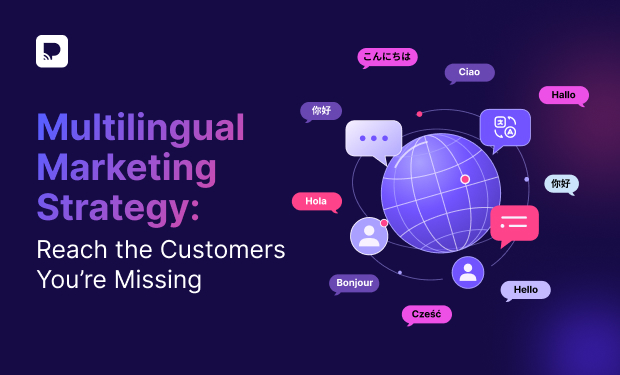
In short: Multilingual marketing means speaking to customers in the language they prefer, and this guide shows why it works, how to build a strategy in six steps, and how to run it without adding to your workload.
People naturally gravitate towards conversations in their native language. It’s what they’re most familiar with, what they express themselves best in, and often what makes communication feel more personal. The same principle applies to marketing.
Your customers might understand English, but that doesn’t necessarily mean it’s the language they feel most connected to. When a business communicates in the languages its audience speaks, it creates more opportunities to connect, engage, and build lasting relationships.
And with businesses increasingly serving diverse communities and expanding into new markets, speaking just one language can limit how far their marketing reaches. A multilingual marketing approach helps bridge that gap, allowing businesses to connect with different audiences in a way that feels more natural to them. But how do you go beyond simply translating your content? What does an effective multilingual marketing strategy look like, and how can it help your business reach more customers?
In this blog, we’ll explore:
- What multilingual marketing is and why it matters.
- How it helps businesses reach and connect with more customers.
- The difference between multilingual marketing and multilingual search marketing.
- How to create an effective multilingual marketing strategy.
- Common challenges and best practices to keep in mind.
- How Practina makes multilingual content creation and advertising easier.
Let’s get started!
What Is Multilingual Marketing?
Multilingual marketing is the practice of creating and delivering marketing content in more than one language so that each audience hears from you in the language it prefers. It covers social media posts, advertisements, website content, email campaigns, and other promotional content.
It isn’t only for businesses expanding internationally. Take a dental clinic in a neighborhood where many residents speak Spanish. If the clinic promotes its services only in English, a large part of its own community may scroll past. Content in both English and Spanish reaches the patients who are already nearby.
Multilingual marketing also goes beyond translating words. A message translated word for word can be grammatically correct and still sound awkward to a native speaker. A good strategy accounts for local expressions, cultural context, and the way people naturally talk.
Reach More Customers with Smarter Marketing
Explore how Practina helps you connect with diverse audiences and grow your business.
Get StartedWhy Multilingual Marketing Matters for Your Business
1. You Reach More of the People Already Around You
Marketing in one language limits your audience to the people who are comfortable in that language. A home services business in a multicultural city that promotes itself in English, Spanish, and one other widely spoken local language gives far more residents a chance to find it and understand what it offers.
2. You Build Trust Faster
People trust what they fully understand. When a customer is comparing providers, a post that explains your services in their everyday language feels more approachable than an English-only graphic they have to work through. The same CSA Research study found that 75% of shoppers are more likely to buy from a brand again when customer care is in their language.
3. You Get More Engagement
People like, comment on, and share content they relate to. A restaurant that announces its seasonal menu in English and French gives two groups in its community a reason to respond instead of one.
4. Your Ads Work Harder
An ad can only persuade someone who understands it. A fitness studio running English and Spanish versions of the same offer puts a clear message in front of both audiences, rather than paying to show one version to people who may skip it.
5. You Can Test New Markets Before Investing Heavily
An e-commerce brand that wants to reach customers in France can start with French-language campaigns alongside its English marketing. The response shows whether the demand is there before the brand commits to a full expansion.
| Marketing opportunity | How multilingual marketing helps | Example |
| Audience reach | Connects you with people who prefer other languages | A local clinic promotes its services in English and Spanish |
| Customer trust | Makes your business feel familiar and accessible | A salon explains its services in the customer’s preferred language |
| Engagement | Gives more people a reason to interact | A retail store publishes product announcements in two languages |
| Ad performance | Puts a clear message in front of each audience | A fitness studio runs English and Spanish versions of one campaign |
| Market expansion | Introduces your brand to new regions at low risk | An online store launches French-language campaigns to test demand |
Multilingual Marketing vs. Multilingual Search Marketing
The two terms are related but not the same. Multilingual marketing covers all of your marketing communication across languages. Multilingual search marketing is one part of it: helping people find your business on search engines in their preferred language.
| Comparison | Multilingual marketing | Multilingual search marketing |
| Primary focus | Communicating with audiences in different languages | Search visibility across different languages |
| Main objective | Awareness, trust, and engagement | Relevant organic and paid search traffic |
| Key activities | Multilingual social posts, ads, emails, and promotional content | Localized SEO, keyword research, multilingual website pages, and search ads |
| Platforms | Social media, ad platforms, email, and websites | Google and other search engines |
| Example | A restaurant shares its offers in English and Spanish | The restaurant optimizes its website for English and Spanish search queries |
How the Two Work Together
Say a wellness clinic wants more Spanish-speaking customers. Its multilingual marketing puts Spanish-language posts, ads, and offers in front of that audience. Its multilingual search marketing adds Spanish-language website pages, keyword research, and search ads, so the clinic also shows up when those customers search.
One makes the clinic easier to find. The other makes it easier to approach once found.
One important distinction: multilingual social media content and ads do not improve your website’s organic search rankings on their own. For that, you need a dedicated multilingual SEO strategy.
How to Create a Multilingual Marketing Strategy in 6 Steps
Translating your existing content is not a strategy. You need to know who you are trying to reach, what they want to know, and how they prefer to communicate.
Step 1: Choose Your Audience and Languages
Start with your existing customers, the communities you serve, and the markets you want to enter. Ask:
- Which languages do your current customers speak?
- Are there specific linguistic communities in your service area?
- Which regions do you want to expand into?
- Which languages do your competitors use?
You don’t need five or six languages on day one. Start with the one or two that matter most to your audience.
Step 2: Understand the Audience Behind the Language
Knowing the language is only the beginning. You also need to know how that audience communicates and what information matters to them.
Phrases, cultural references, and promotional messages do not always carry the same meaning across communities. Tone matters too: a casual campaign may suit a younger audience, while a healthcare business usually needs a more informative, reassuring voice.
Step 3: Translate and Localize Your Content
Translation converts your message from one language to another. Localization adapts it to the preferences, cultural context, and communication style of a specific audience. You need both.
| Original English message | Spanish version | Marketing purpose |
| Your smile deserves the best care! | ¡Tu sonrisa merece el mejor cuidado | Introduce a dental service in a friendly, approachable way |
| Book your first appointment today! | ¡Agenda tu primera cita hoy! | Encourage potential patients to take action |
The message stays the same, and it sounds natural in the target language. For important campaigns, have a fluent speaker or language professional review the final content, especially industry terms and promotional claims.
Step 4: Adapt Your Content and Ads for Each Platform
A social post, an Instagram ad, and a Google search ad have different requirements. Copying the same translated text everywhere rarely gives the best results.
- Facebook and Instagram: Create posts, creatives, and ads in each target language.
- Google Ads: Use localized ad copy and keywords people search for in that language.
- LinkedIn: Adapt professional messaging to the language of your business audience.
When you run ads, three setup choices make the difference:
- Separate each language. Give every language its own campaign or ad set so the budget and results stay separate.
- Set language targeting. Use the platform’s language targeting so each version reaches people who use that language.
- Match the landing page. Send a Spanish ad to a Spanish page or lead form. A Spanish ad that opens an English page loses the customer at the last step.
Step 5: Keep One Brand Voice in Every Language
Your business should feel like the same business in every language. If your English content is warm and reassuring, your Spanish content should be too. The language changes; the brand personality does not.
Step 6: Track Performance by Language and Improve
A multilingual strategy needs regular review. Track these metrics separately for each language:
- Reach and impressions
- Engagement rate (likes, comments, shares)
- Click-through rate on ads
- Leads and inquiries
- Conversions and cost per lead
If your Spanish-language Facebook ads bring in more inquiries than your English campaign, find out why. It could be the messaging, the targeting, the offer, or a mix of all three. Use what you learn to adjust the next campaign.
Go Beyond Language Barriers
Discover how Practina helps you reach and engage more customers.
Grow Your ReachCommon Multilingual Marketing Challenges and How to Solve Them
Running campaigns in several languages brings a few predictable problems. Each one has a practical fix.
| Challenge | Why it happens | How to solve it |
| Inaccurate translations | Direct translation misses context, expressions, or industry terms | Have a native speaker review important content |
| Inconsistent brand voice | Different people or tools create each language version | Set clear brand guidelines and one messaging framework |
| Too many campaigns to manage | Creating, scheduling, and monitoring content in several languages takes time | Manage all content and campaigns from one platform |
| Cultural differences | A message that works in one market falls flat in another | Research each audience and adapt the message |
| Results are hard to compare | Data from different languages gets mixed together | Track key metrics separately for each language |
| Limited resources | Translators and extra workflows add cost | Use AI-powered content tools, with human review where accuracy matters |
Multilingual Marketing Best Practices
Once your strategy is in place, these five habits keep it working.
1. Write for Native Speakers, Not for Accuracy Alone
A technically correct translation is not always a good marketing message. Read every version the way a native speaker would. If it sounds stiff, rewrite it.
2. Adapt Your Creatives Along With Your Copy
Language is more than captions and headlines. Text inside images, calls to action, and visuals should all make sense to the audience you are targeting.
3. Review Before You Publish
Check translations, grammar, terminology, and cultural context before content goes live. This matters most in healthcare, finance, and other industries where accuracy is critical.
4. Use Automation for the Repetitive Work
Creating every language version by hand takes hours. AI-powered tools such as Practina generate posts and ads in multiple languages, so your team can spend its time on review and strategy.
5. Expand Based on Results
Watch which languages and messages bring real engagement and leads. Add a new language when the data supports it, not before.
How Practina Makes Multilingual Marketing Easier
Reaching customers in several languages is a real opportunity. Creating and managing every version yourself is the hard part. Practina takes that work off your plate.
With Practina, you can create social media posts and ads in 10+ languages, including English, Spanish, French, German, Portuguese, Polish, Thai, and Vietnamese.
1. Social Media Posts in Your Customers’ Language
Select a language and Practina generates the post in it. Promote a service, share an update, or announce an offer in the language that suits each audience, and keep your brand active for all of them.
2. Ads in Multiple Languages
Create ads in the language your audience speaks instead of relying on one English campaign. This is especially useful for businesses serving multilingual communities or testing a new market.
3. A Dashboard in Your Own Language
Your team should be comfortable too. Practina lets you choose the language of your dashboard, with options including English, Spanish, French, German, and Hindi.
4. All Your Marketing in One Place
Content creation, advertising, and scheduling can be managed in one platform, so you oversee every language version from the same place. Practina also covers payments with Practina Pay and the Terminal, so the tools that bring customers in and the tools that get you paid work side by side.
Different customers. Different languages. One platform to reach them.
Start for free or book a demo to see how Practina handles multilingual marketing for your business.
Conclusion
Your customers don’t all communicate in the same language, so why should your marketing?
The more your communication reflects the languages your customers speak, the easier it becomes to reach them, earn their trust, and turn interest into business. Start with one additional language, measure the response, and build from there.
And with tools like Practina, creating multilingual posts and ads doesn’t have to add hours to your marketing routine.
Sometimes, reaching more customers starts with something as simple as speaking their language.
FAQs
Q: What is multilingual marketing?
A: Multilingual marketing is the practice of promoting a business, product, or service in more than one language. It includes social media posts, ads, website content, emails, and other marketing material created in the languages customers prefer.
Q: Why is multilingual marketing important for small businesses?
A: It helps small businesses reach more of their local community, build trust with customers who prefer another language, and test new markets at low cost.
Q: What is the difference between multilingual marketing and multilingual SEO?
A: Multilingual marketing covers communication across all marketing channels. Multilingual SEO focuses on website content, keywords, and other search elements so a business appears in search results in different languages.
Q: Can AI help with multilingual marketing?
A: Yes. AI-powered marketing tools generate posts and ads in multiple languages, which cuts the time needed to create each version. Content should still be reviewed for accuracy, context, and cultural relevance.
Q: How many languages should a business use in its marketing?
A: There is no fixed number. Start with the languages most common among your existing and potential customers, then add more as results justify it.
Q: How does Practina help with multilingual marketing?
A: Practina lets businesses create social media posts and ads in 10+ languages and choose the language of their dashboard, so teams can manage multilingual marketing from one platform.