


There was a time when discovering a business online meant one thing. Customers typed a query into a search engine. Scrolled through endless links. Clicked through pages. Researched like their life depended on it. And somewhere on page one, hopefully near the top, settled on a satisfactory answer.
For years, this was core browser behavior. And it influenced how websites were built, how content was written, and how marketing teams operated. Entire industries competed for one thing: ranking higher. “SEO, SEO, and SEO.” Then something changed, quietly at first, then drastically.
People stopped searching the old way. Today, instead of scrolling through ten blue links, people ask a question and expect a direct answer. Not from a website. From an AI engine. And they trust it.
This is the shift most brands are still coming to terms with. The ones who recognize it now will not just adapt. They will lead.
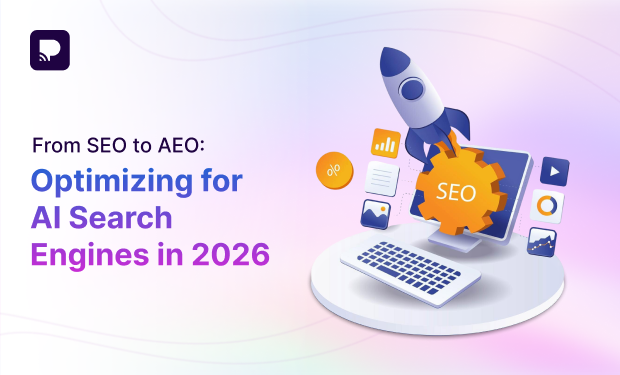
This guide breaks down exactly how we got here, why traditional SEO is no longer enough, what AEO actually means, and how brands should think about visibility in 2026 and beyond.
It all started with SEO. Let’s begin there.
Start Optimizing for AI Search—Automatically with Practina
Let Practina handle optimization while you focus on growth.
Get StartedWhat SEO Is and Why It Became the Backbone of Digital Marketing
SEO stands for Search Engine Optimization. At its core, SEO is the practice of optimizing digital content so search engines can understand it, rank it, and present it to users when they search for something relevant.
In simple terms, SEO helped businesses get found. But to understand why SEO became so powerful, you have to look at how search itself evolved.
The Rise of Search and the Birth of SEO
In the early 2000s, search engines like Google changed how people accessed information. Instead of directories or portals, users could type questions directly.
Google rewarded relevance, structure, and authority.
This gave way to SEO.
Brands learned that by using the right keywords, building links, optimizing pages, and publishing content regularly, they could appear higher in search results.
As internet usage exploded, SEO followed.
By the late 2000s and early 2010s:
- Google processed billions of searches per day
- Search became the primary discovery channel for businesses
- Ranking on page one could define success or failure
According to Google itself, over 90 percent of online experiences began with a search engine during this period.
SEO became non-negotiable.
Why SEO Dominated Marketing Strategies for So Long
SEO worked because search behavior was predictable.
People:
- Typed keywords
- Compared multiple results
- Clicked through several pages
- Took time to decide
This made SEO incredibly valuable for:
- Content marketing
- Lead generation
- Ecommerce
- Local businesses
- SaaS and enterprise brands
It also fit perfectly into long term strategy. Rankings compounded over time. Authority built gradually. Traffic was measurable.
For years, SEO was not just a channel. It was the foundation.
The Internet Changed. Behavior Changed. Discovery Changed
For a long time, SEO kept evolving. Algorithms improved. Content quality mattered more. User experience became a ranking factor.
But the core behavior stayed the same. Until AI entered the picture.
The real shift did not happen when AI tools launched. It happened when people started trusting them.
The Moment SEO Started Falling Short
The introduction of AI powered search experiences changed one fundamental thing. The interface. Instead of results, users started getting answers.
Google introduced featured snippets and zero click results. Voice assistants gave spoken responses. Then generative AI engines entered mainstream use.
Gartner predicts that traditional search traffic will drop by 25 percent by 2026 due to AI powered answers and virtual agents.
SEO was built for clicks. AI search is built for decisions. That is the difference.
Why Traditional SEO Alone Is No Longer Enough
SEO did not suddenly stop working. It simply stopped being sufficient. Here is where SEO falls short in an AI driven discovery world.
1. AI does not rank pages the way search engines do
AI engines do not scroll through pages and rank ten results.
They synthesize information and choose what to say.
That means being number one is no longer the goal. Being selected is.
2. Keywords matter less than clarity
AI engines do not need keyword stuffing to understand relevance. They look for clear answers, structured information, and consistency across sources.
A perfectly optimized page with vague messaging still loses.
3. Authority is evaluated across the web, not just your site
SEO focused heavily on on site optimization and backlinks.
AI looks at:
- Reviews
- Mentions
- Social signals
- Listings
- Third party validation
- Brand consistency
If your authority is fragmented, AI does not trust you.
4. Freshness is non negotiable
Static content that ranks for years is less valuable to AI.
AI engines favor brands that look active, updated, and engaged right now.
5. SEO optimizes pages. AI evaluates brands
This is the biggest gap.
SEO optimized assets.
AI evaluates entities.
Your entire digital footprint becomes the input.
6. Click based metrics no longer reflect visibility
You can lose visibility without losing rankings.
If AI answers replace clicks, your analytics look fine while your leads drop.
That is why many brands feel something is off but cannot explain it.
Enter AEO: Answer Engine Optimization
AEO stands for Answer Engine Optimization.
It is the practice of optimizing your brand so AI engines can confidently select, reference, and recommend you as the answer. AEO is not an extension of SEO. It is a different model built for a different discovery system.
How AEO Works at a High Level
AI engines work by scanning signals, not just pages.
They look for:
- Trust
- Consistency
- Activity
- Clarity
- Credibility
Then they generate a response.
If your brand provides enough reliable signals, you get included. If not, you are ignored completely.
There is no second page.
What AEO Actually Optimizes
AEO focuses on how your brand is understood by AI systems.
That includes:
◾ Brand entity clarity
Who you are, what you do, where you operate, and why you are relevant.
◾ Trust signals
Reviews, ratings, expertise markers, authority mentions, sentiment patterns.
◾ Activity signals
Recent posts, updates, engagement, fresh content, operational signals.
◾ Offer signals
Clear services, pricing cues, deals, availability, booking options.
◾ Content alignment
Whether your content answers real questions people are asking today.
AEO Metrics That Actually Matter
Unlike SEO, where rankings and traffic dominated, AEO focuses on different indicators.
Key AEO metrics include:
- AI generated citations
- Inclusion in AI responses
- Question driven visibility
- Brand mention frequency
- Trust score indicators
- Activity strength
- Offer clarity signals
- Conversion quality from AI referrals
These metrics show whether AI engines recognize your brand as a valid source.
AEO isn’t optional in 2026—it’s foundational.
Practina helps you adapt by generating AI-friendly, question-based, and structured content built
Get StartedSEO vs AEO: A Complete Comparison
| Primary goal | Rank pages | Be selected as the answer |
| Discovery model | Link based | Response based |
| User behavior | Search and click | Ask and decide |
| Focus | Keywords and pages | Brand signals and clarity |
| Authority | Backlinks | Trust footprint |
| Freshness | Helpful but optional | Critical |
| Metrics | Rankings, traffic | AI mentions, trust signals |
| Competition | Page level | Brand level |
| Visibility | Gradual | Binary |
| Outcome | Visits | Decisions |
The Reality of Discovery Today
People no longer browse. They ask. And AI answers.
This changes everything. According to Microsoft and OpenAI usage trends:
- Users treat AI responses as final answers
- Follow up questions replace further searching
- Brand selection happens instantly
If your brand is not part of that answer, you are invisible.
The Visibility Gap Most Businesses Are Experiencing
This is where brands get confused. Leads drop. Traffic looks stable. Campaigns have not changed. But visibility has shifted.
People ask:
- Who is the best dentist near me
- Which salon is open after 8 pm
- Which realtor offers flexible payment options
AI gives one answer. That answer captures the demand. This is the visibility gap. It is silent. It is sudden. And it is expensive.
Why Early Action Matters
AI engines learn over time.
They reward:
- Consistency
- Long term activity
- Stable trust signals
Brands that start early build authority faster. Brands that wait have to fight uphill.
This is not a trend cycle. It is a platform shift.
Where Practina Fits In
Practina helps brands close the AI visibility gap by strengthening every signal AI engines rely on.
It focuses on:
- Trust signals through reputation and reviews
- Activity signals through consistent updates and content
- Offer signals through clear deals and service markers
Together, these turn your digital presence into something AI can interpret and recommend.
Not by chasing algorithms. By building clarity.
Conclusion
SEO helped brands get found. AEO helps brands get chosen. As discovery moves from links to answers, visibility will belong to the brands AI trusts most.
This shift is already happening. The only question is whether your brand is preparing for it now or reacting later.
FAQs
Q: Is SEO still relevant in 2026?
A: Yes. SEO still matters, but it is no longer enough on its own. Ranking pages helps, but AI engines do not rely only on rankings. They look at brand trust, clarity, and activity across the web. SEO is now a foundation, not the finish line.
Q: What is the biggest difference between SEO and AEO?
A: ▪ SEO helps your website get clicked.
▪ AEO helps your brand get chosen.
SEO competes for position in search results. AEO competes for inclusion in AI generated answers. One drives traffic. The other drives decisions.
Q: Does AEO replace SEO?
A: No. AEO does not replace SEO. It builds on it.
SEO optimizes pages. AEO optimizes your entire digital presence so AI engines can understand, trust, and recommend your brand. Brands that rely only on SEO risk losing visibility without realizing why.
Q: Why are businesses losing visibility even when rankings look fine?
A: Because visibility is no longer measured only by clicks.Many searches now end without a website visit. AI answers replace links. Your rankings can stay the same while your leads drop. This is the visibility gap most businesses experience before they understand AEO.
Q: What signals do AI engines actually care about?
A: AI engines look at signals like:
- Trust and review quality
- Brand consistency across platforms
- Recent activity and updates
- Clear services, offers, and availability
- Mentions and credibility from other sources
If these signals are weak or inconsistent, AI cannot confidently recommend your brand.
Q: When should a business start focusing on AEO?
A: Now. AI engines reward long term consistency. Brands that start early build trust faster and are easier for AI to recognize. Waiting does not pause the shift. It only makes catching up harder.